
Tension Rods (Tie Rods) / PC Steel Bars(Architectural – Steel Frame Work、For reinforced concrete construction)
A wide lineup of tensile members for beam string structures, suspended structures, and more
Tension rods (tie rods) are classified by application into beam string members, braces, suspension members, and sway-prevention members. By material, they are classified into mild steel, high-tensile steel, and PC steel bars.
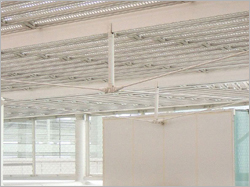
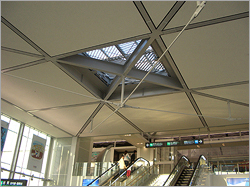
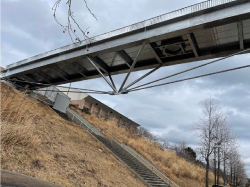
Mild-Steel Tension Rods (Tie Rods)
These tension rods (tie rods) are manufactured using mild steel, such as SS materials, as the main material. Because they are not particularly high in strength, they cannot bear very large loads. However, they can be manufactured down to small diameters (small cross sections), making them the most common and widely used type.
| Category | Material | Yield Point | Tensile Strength | Size | Remarks |
|---|---|---|---|---|---|
| (N/mm2) | (N/mm2) | ||||
| Mild-Steel Tension Rods (Tie Rods) | SS400 | 245(235,215)and above | 400~510 | Φ12~100 | |
| SS490 | 285(275,255)and above | 490~610 | Φ12~100 | ||
| SNR400A | 235(215)~355(335) | 400~510 | Φ16~100 | ||
| SNR490B | 325(295)~445(415) | 490~610 | Φ16~100 |
High-Tensile Steel Tension Rods (Tie Rods)
These tension rods (tie rods) are used when a larger load than mild steel can support is required. They are manufactured using manganese steel. The two common classes are F-value 45 kg/mm² class and 54 kg/mm² class. Sizes range from φ25 to φ90.
| Category | Material | Yield Point | Tensile Strength | Size | Remarks |
|---|---|---|---|---|---|
| (N/mm2) | (N/mm2) | ||||
| High-Tensile Steel Tension Rods (Tie Rods) | 440 N/mm2Grade | 440and above | 690and above | Φ25~90 | |
| 540 N/mm2Grade | 540 | 740and above | Φ25~90 |
PC Steel Bars
These tension rods (tie rods) are manufactured using materials with higher strength than high-tensile steel tension rods (tie rods). While they offer high strength, there are restrictions in use, such as low elongation and the inability to apply plating. Sizes range from φ9 to φ40.
| Category | Material | Symbol | Proof Stress | Tensile Strength | Size | Remarks |
|---|---|---|---|---|---|---|
| (N/mm2) | (N/mm2) | |||||
| PC Steel Bars | Class A, No. 2 | SBPR 785/1030 |
785and above | 1030and above | Φ10~40 | |
| Class B, No. 1 | SBPR 930/1080 |
930and above | 1080and above | Φ10~40 | ||
| Class C, No. 1 | SBPR 1080/1230 |
1080and above | 1230and above | Φ10~40 |
Stainless Steel Tension Rods (Tie Rods)
These tension rods (tie rods) are manufactured using austenitic materials. After processing, solution heat treatment and surface treatment are required. They are often used outdoors, but contact with dissimilar metals such as aluminum must be avoided.
| Category | Material | 0.1% Proof Stress | Tensile Strength | Size | Remarks |
|---|---|---|---|---|---|
| (N/mm2) | (N/mm2) | ||||
| Stainless Steel Tension Rods (Tie Rods) | SUS304A | 235and above | 520and above | Φ8~60 | Yield ratio of 60% or higher |
| SUS304N2A | 235and above | 690and above | Φ8~60 | Yield ratio of 60% or higher | |
| SUS316A | 235and above | 520and above | Φ8~60 | Yield ratio of 60% or higher |
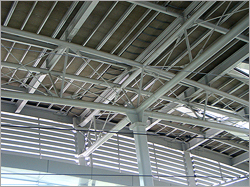
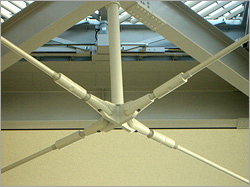
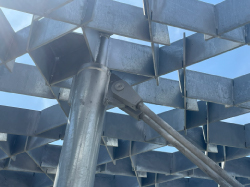
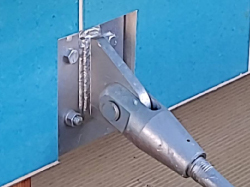
Tension Rod (Tie Rod) Connecting Components
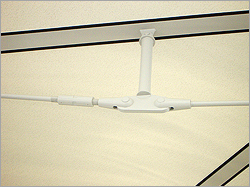
Turnbuckle
Used for length adjustment and tension introduction.
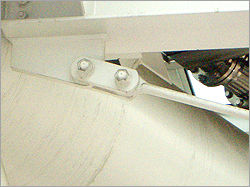
Turnbuckle
Connected using two plates and a pin.
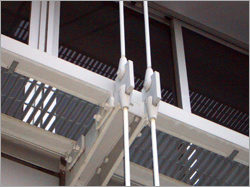
Fork End
Connected with a pin while sandwiching a gusset plate.
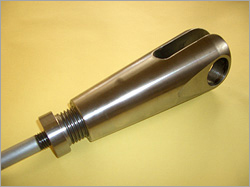
Fork End (with Adjustment Bolt)
Because an adjustment bolt is built into the fork end, it has a length-adjustment function.
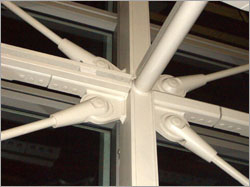
Fork End
Two plates sandwich the gusset plate and are connected with a pin bolt.
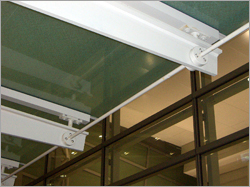
Connecting Member (1) [Sway Prevention]
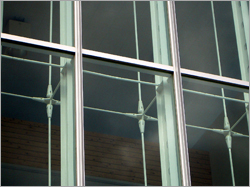
Connecting Member (2) [Sway Prevention]
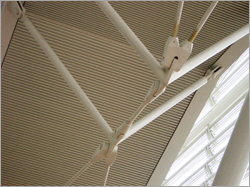
Special Fork End
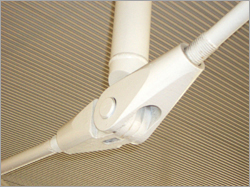
Special Fork End
(Eye End and Fork End)